

INSIGHTS ABOUT THE VARIOUS CULTURES IN UGANDA.
Uganda is a diverse country with over 56 different ethnic groups. It is divided into the Bantu-speaking groups in the west, central, and south, as well as the Nilotic groups in the north and east, all having distinct ways of living. Some of these groups include the Baganda, Bagisu, Batooro, Batwa, Acholi, Karamojong, Banyankore, Bakiga, and Bakonjo. They live in different areas of Uganda. Their cultures are rooted in communal responsibility, traditional music, vibrant ceremonies, cultural food, unique dress code, and different languages.
THE BAGANDA CULTURE.
They are the largest ethnic group in Uganda, mainly found in the central region of Uganda. They are headed by a king known as “Kabaka.” He is also known as “Ssaabataka,” meaning the supreme leader of all clan heads. Their language is Luganda. Their throne is known as “Namulondo,” which is absolute over cultural matters. The Buganda Parliament convenes at Bulange, Mengo, to manage kingdom affairs. The queen of Buganda is known as “Nabageleka,” who leads the preservation of values among women in the kingdom.
The throne of Buganda belongs to the royal family. The firstborn son, known as “kiweewa,” is excluded from the race to become king. This is because his role is to protect the young brothers and the family. He also allows the young brothers, known as “Abarangira,” to remain eligible to become the next king. The vetting council evaluates the behaviours, leadership potential, character, and physical health of the princes. If the sitting king is selected to choose his successor before his passing, he does so in secrecy.
In a private ceremony, the selected successor is given a special piece of traditional bark cloth. He is kept secret from the public until the king passes away, when the chosen king steps forward. He lays his special back cloth over the body of the late king, which is termed “Okwabya Olumbe.” This reveals him to the family and the kingdom as well as the chosen successor.
Tradition and customs of the Baganda culture
The Baganda culture is highly symbolic due to different aspects of their culture. Every Muganda has a clan inherited from their ancestors. It is structured in a hierarchy that follows a fixed order from the head, known as Akasolya, divided into branches known as Amasiga. Then to lineages known as enyiriri. These clans have totems, each known as omuziro, where each has a main totem such as a bird, animal, or plant. They also have a secondary totem called Akabiro. Marriage within one’s own clan or mother’s clan is prohibited.
The Baganda have a dress code, which is the Kanzu for men and the Gomesi for women. Baganda marriage is known as Kukyala, which is a pre-visit, and Kwanjura, which is the official introduction. This is where the groom’s family meets the bride’s family to bring bride price such as kanzu for the father, gomesi for the aunt known as Senga, crates of soda, and local beer. Their local food is known as luwombo, which is chicken or beef inside a sealed pocket of banana leaves. Women and girls greet by kneeling, especially elders. Their traditional dances are known as Bakisimba, Nankasa, and Muwogola. The birth of twins in Baganda, known as “Abalongo,” holds a deep spiritual meaning. This is why clan rituals known as “Okwalula Abalongo” are performed.
THE BANYANKORE CULTURE.
Banyankore are found in western Uganda, and they are divided into two groups. That is the Bahima (Pastoralists), who are well known for keeping long-horned cattle, and the Bairu (Agriculturalists), who are well known as cultivators. They are divided into clans known as Enganda, which are also subdivided into four major roots: Abahinda, Abashambo, Abeishikatwa, and Abagahe.
The Banyankore are headed by a king known as “Omugabe,” and their royal throne was known as Bagyendanwa. The king was selected from the sons of the reigning king. They would fight a war of succession known as “Okwettonda.” The one who wins the war by killing his brothers or forcing them into exile becomes the next king.
The Banyankore marriage is known as okwanjura, where the middleman known as kateerarume initiates the marriage proposal with the girl’s family and handles early negotiations. The bride price is known as enjugano, which includes cows and goats. The public giveaway is known as okuhingira, where the girl is officially given to the boy.
The Banyankore dress code is ekitambi and omwenda for the women and ekanzu for men. Their staple local food is millet bread known as “akalo” and cream sauce made out of cow ghee known as “eshabwe,” as well as cow milk, which is “amate.” Their local dance is ekitaguriro, and their language is known as Runyankore. They believe so much in storytelling as a means of entertainment.
THE BAGISU CULTURE.
The Bagisu, also known as the Bamasaba, are the Bantu-speaking group living on the steep slopes of Mount Elgon in eastern Uganda. They are located in the districts of Mbale, Sironko, Manawula, Bududa, and Bulambuli. Bagisu are well known for public circumcision. Bagisu trace their lineage from their founding ancestors, Mundu and Sera, where Mundu fathered Masaba, meaning the mountain. Their local language is known as Lumasaba, and they are divided into small clans known as Obusa, such as the Bakhone, Bamwamba, and Basobeti.
The Bagisu do not have a permanent royal bloodline where the new king is selected by the elected cultural office after five years. They have the three ancestral family pillars, which are Mwambu, Mubuuya, and Wanaale. For one to qualify for the election, one must meet cultural benchmarks such as having undergone the traditional imbalu circumcision rite.
The greatest pillar of the Bagisu is the imbalu. This is a public, non-medical male circumcision, which is a spiritual transformation that turns a boy (musinde) into a man (mutsetsa). It is a sign of a spiritual call that is ushered in by the arrival of the specific local bird. The eligible boys feel the restless urge to undergo circumcision. If one tries to hide, he is hunted by the community and forced to circumcise. This is a sign of bravery, as they are being administered a traditional herb known as ityanyi. The boy must not blink or show any sign of pain. There is also the post-ritual re-entry known as iremba. Here. The boy cannot feed himself but is fed by the caretaker.
Traditional marriage in the Bagisu culture
The marriage customs involve the boy’s family bringing bride price known as luyali. It includes cows, goats, and local banana beer known as kamalwa, to the girl’s family. The local food for Bagisu is Malewa from wild bamboo shoots harvested from the forests of Mount Elgon. It is smoke-dried, sliced into small pieces, boiled with rock salt known as madii, and stewed in a rich velvet peanut paste, traditionally eaten alongside steamed matooke or millet bread. Their traditional dance is known as the kadodi and isonja pre-dances. The Bagisu had their spiritual life and believed in their spiritual God known as wele namanga. He governed through three distinct assistants known as wele maina, the deity overseeing livestock; nabulondela, the spirit that governed child births; and wele namakanda, the deity of soil fertility.
THE KARAMAJONG CULTURE
The Karamojong are a Nilotic semi-nomadic ethnic group living in the Karamoja region in northeastern Uganda. They depend on cattle, representing wealth, status, and prestige. Their society is defined by communal homesteads called Manyattas. They are believed to have migrated from Ethiopia. The name Karamoja comes from the phrase ekar ngimor, which means “the old men can walk no further.” This indicates how the group split from their relatives, such as the Maasai and Turkana, to settle in the region. Their language is Ngakarimojong.
The Karamojong practice transhumance due to a semi-arid climate. Therefore, during the dry season, they establish temporary camps called kraals near seasonal rivers with herds of cattle in search of fresh water and pasture for grazing. The Karamojong are known to be warriors and violent people.
The society does not have centralised leaders, but rather they are organized into different age groups and generations. Power rests in the hands of the elders, while the young men (Moran) are the protectors of homesteads and livestock. They feed on dairy products, fresh blood drawn from cows without harming the cow, and meat.
Marriage among the Karamojong
The man is required to wrestle with the woman he desires to marry. If he wins her, he is considered to be a man and allowed to marry her. The man seeking to marry should be strong enough to care for and protect his wife from any harm. The groom’s family pays a large bride price of cattle to the bride’s family. A woman’s jewelry is used as a ledger of their marital status. For instance, the number of metallic bangles a woman wears around her ankles can indicate how many cows her husband paid for her dowry.
The Karamojong believe in a supreme god known as Akuj, who protects them and their herds. They heavily practice ancestral worship and animal rituals. Karamojong live in communal villages known as the manyattas (ere) surrounded by dense thorn-bush fences. The Karamojong dress up in suka, which is a colorful heavy cotton sheet wrapped tightly over the shoulder. Women wear multi-layered, heavily pleated cowhide.
THE BATOORO CULTURE.
The Batooro are a Bantu ethnic group living in the Tooro Kingdom in western Uganda. They speak Rutooro. Batooro are well known for their politeness, graceful traditions, cultural pride, the centralised monarchy, and unique social naming known as empaako. The Batooro are a part of the Bunyoro-Kitara Empire and are ruled by the king known as omukama. It was established in 1830 by Prince Kaboyo Olimi I. The palace sits at Karuzika Hill in Fort Portal.
In Tooro culture, the leadership is hereditary for males from the Babiito Dynasty of the Bunyoro-Kitara Empire. When the king (omukama) dies, the crown prince (omuhena), who is tested by the omusuuga, the head of the royal clan, is officially declared the heir-apparent. The prospective king fights a mock battle at the gates of Tooro Kingdom Palace. His win is a sign that he has the power to protect the kingdom.
The Batooro society is divided along economic lines rather than harsh castes. These include the Bahuma, who were cattle keepers, and the Bairu, who were cultivators. Every Mutooro child receives one of the designated empaako praise name system. This name may reflect a significant event that happened at the time of birth. This takes place when the baby is four days old if he is a male and three days old if she is a female. The paternal aunts analyze the baby’s physical traits to find resemblances to ancestors before the clan chief assigns the Empaako. The ritual concludes with a communal meal of millet and smoked beef followed by planting a symbolic tree. A banana tree for a girl to signify sustenance and a sycamore tree for boys to show perpetuity.
Marriage in Batooro culture
The Batooro marriage is known as okwanjula, where the groom’s family meets the bride’s home to pay bride price, known as enjugano. It consists of cows, bark cloth, and local brew. Marriage arrangements involve a middleman known as kirangabuko. He negotiates on behalf of the boy’s family.
The Batooro dress up in an elegant and modest dress code of the suuka and ekitambi for women and the kanzu for men. The staple food for the Batooro is kalo, which is millet mingled with cassava, and eshabwe, which is cream from cow ghee. Their traditional dance is the amakondere dance. They blow wooden trumpets known as amakondere and beat traditional drums known as entimba.
THE BATWA CULTURE
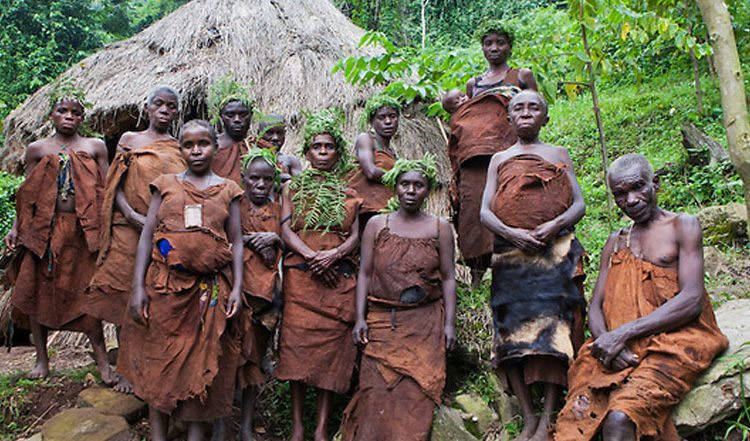
The Batwa pygmies, also known as the forest keepers, are one of Africa’s oldest indigenous tribes. They came from central Africa and lived as hunter-gatherers, speaking Rutwa as their language. Batwa now live in communities neighboring various rainforests of Uganda, Rwanda, Burundi, and DRC. They have lived in this region of the Great Lakes for over 60,000 years. They were considered guardians of the jungle, but this changed when the rainforests such as Bwindi and Mgahinga were designated as national parks.
The Batwa men hunted monkeys, birds, and bush pigs using bows, arrows, and nets. They never overhunted, while women gathered wild fruits, berries, and medicinal plants. They lived without money and were self-sufficient, famously sharing the forest with gorillas. Their short stature of 1.5 meters for men was an evolutionary adaptation that allowed them to navigate dense undergrowth.
The Batwa Pygmies built temporary huts made of branches and leaves, like the famous Garama Caves in Mgahinga, for shelter because they moved frequently in search of food. They built woven nest platforms surrounded by fire to protect the children from tree-climbing predators.
The Batwa lived in organized clans led by elders, and marriage within the same clan is prohibited to avoid inbreeding. They worship a god known as Nyabingi who was always consulted before and after hunting for protection, success, and good health, as well as offering a portion of their catch as sacrifice.
The Batwa women are highly skilled in weaving mats and baskets from natural materials like papyrus and grass. Music is part of their culture, used for storytelling, rituals, and communal celebrations, and their dances mimic the movements of animals and sounds of the forest.
THE BAKIGA CULTURE.
The Bakiga, which means “The People of Mountains,” are a Bantu-speaking ethnic group living in the Kigezi region in southwestern Uganda, in the districts of Kabale, Kanungu, and Rukungiri, speaking Rukiga as their language. They are well known for their resilience, hard work, clan-based society, and their culture revolves around community, agriculture, and rich artistic traditions.
The Bakiga live in clans governed by elders rather than a centralised monarchy, and they are known for cultivating crops like millet, sorghum, peas, beans, sweet potatoes, and Irish potatoes. They are also skilled in weaving; they are potters. They lived in communal homesteads including the main hut, kitchen, granaries, and animal kraals, which were heavily fortified with thorny fences to protect them against wildlife and invaders.
The staple foods for the Bakiga are sorghum, millet, and beans, and they have their local beer known as sorghum beer. Marriage in Bakiga is known as okushwera, where the boy’s family pays bride price, including cows and goats, and it is involved by both families, especially the paternal aunt known as ishenkazi and the paternal uncle known as nyinarimi. Virginity was highly esteemed, and pre-marital pregnancy was met with extreme punishments.
The Bakiga believed in their god known as Ruhanga and also had prominent cults such as the nyabingi spirit associated with a highly respected rainmaker. Their traditional dance is known as ekizino.
THE ACHOLI CULTURE
The Acholi are a prominent Nilotic ethnic group living in the northern part of Uganda speaking Luo as their language. The name Acholi comes from a combination of Luo and neighboring dialects, meaning “I am a man of the black people. The Acholi migrated from the Bahr El Ghazal region of South Sudan between the 15th and 17th centuries. They are culturally tied to the elephant known as Achi which symbolizes intelligence, power, and resilience.
The Acholi are divided into 54 major clans, and each village was led by the great chief known as Rwot. The unifying cultural institution is the Ker Kwaro Acholi, led by the Paramount Chief, and the current chief is Rwot David Onen Acana II. The elders known as Ladit Kaka are respected as custodians of wisdom, law, and history.
The Acholi dances are bwola, where they dance in a circle, and Lara karaka, where young people dance to attract partners. They use instruments such as the adungu and the nanga to produce sound. The Acholi staple food is millet eaten as porridge known as lakorikori. The highly celebrated local dish is malakwang made up of vegetables mixed with groundnuts.
Marriage is highly respected in the Acholi culture, and it involves a multi-day introduction and bride price ceremony that highly emphasizes family integration, deep respect for elders, and formal blessings from both parents. They also have a famous mechanism, which is the Mato Oput, meaning “drinking the bitter herb,” a cleansing and reconciliation ritual designed to bring victims and perpetrators together to ask for forgiveness and prevent revenge.
THE BAKONZO CULTURE.
The Bakonzo are a Bantu-speaking group living on the slopes of Mount Rwenzori in western Uganda in the districts of Kasese, Kabarole, and Bundibugyo. They belong to the Bayiira group, and they lived in councils of elders that were answerable to the king, who is known as Omusinga. The king is chosen through hereditary succession tied to the legacy of the Rwenzururu Movement, where the chosen son in the royal lineage takes the crown. The Bakonzo have their kingdom known as the Rwenzururu Kingdom and they live in rectangular houses made of bamboo and clay, made to withstand the heavy rains of the mountains. They speak Lhukonzo as their language.
The Bakonzo believe in Mount Rwenzori as a source of their economic blessings as well as a place for their ancestral spirits such as Kitasamba and Ndyoka, and the steep slopes provided defense against hazards, wars, and diseases. They performed rituals such as the erection of hunters’ shrines for animal sacrifices to exorcise evil spirits.
The Bakonzo value hard work and respect for elders. They perform male circumcision, known as Olhusumba, as a sign of transition from boyhood to adulthood, and an uncircumcised man among the Bakonzo is not recognized as an adult. The Bakonzo believed in the ancestral spirits of Nyabarika the spirit of life, death, and hunting, as well as Kalisa, the forest spirit associated with hunting. The Bakonzo are agriculturalists, growing matooke, yams, potatoes, cassava, beans, cocoa, coffee, cotton, and keeping goats, sheep, and poultry. Their traditional dance is Amasinduka, and they use traditional wooden horns and small drums to produce sound. Marriage is done where the parents take the lead in scouting for the suitable girl for their son.